Game Server Hosting in India: The Honest Reality Nobody Talks About
A deep research piece on game server hosting in India in 2026. Written from 6 years of personal experience running FiveM and Minecraft servers. For Indian players, server owners, and hosting companies thinking about entering this market.

Author
Yuvraj Verma
Technical Content Creator | M.E. CSE student focused on Cloud Computing

I still remember the first time I tried to buy a game server.
I was maybe 16, sitting at my desk in Punjab, and I had spent three weeks watching tutorials on how to set up a FiveM roleplay server. I had the scripts downloaded, the database configured, the Discord made. All I needed was the actual server.
I went to ZAP-Hosting. Added the plan to cart. Entered my card details. Rejected.
I did not have an international card. Most Indian debit cards at the time did not work on foreign payment gateways. So I called my friend, explained what I needed, sent him the money via UPI, and he used his card to buy the server for me.
That was my introduction to game server hosting in India. Six years later, the fundamentals of that experience have not changed as much as they should have.
I have been building FiveM and Minecraft servers since 2020. I run a YouTube channel with nearly 10,000 subscribers built almost entirely on server tutorials and hosting content. I have gone through probably a dozen hosting providers across four countries. I have been rejected by Indian VPS providers who thought I was trying to host a gambling operation. I have watched Indian server communities build something real over six weeks of summer vacation and then watch it disappear when college reopened.
This post is the one I wish had existed when I started. It is not a top 10 list. It is not written by someone who signed up for a free trial to produce content. It is six years of firsthand experience, combined with research done specifically for this piece, with sources and honest conclusions.
About the Author
I am Yuvraj Verma. I have been creating technical content on server infrastructure, hosting, and game server development since 2020. My YouTube channel has covered everything from setting up your first FiveM server to Pterodactyl panel installation to running your own hosting business. I am not sponsored by any hosting company for this article. Every opinion here is my own.
You can watch my full game server hosting tutorial series here:
The Scale of What Is Being Underserved
Before getting into the specifics, the opportunity needs to be stated clearly.
Source: Niko Partners via TechnoSports, June 2026
India crossed 511 million gamers in 2025. That number is expected to reach 550 million by end of 2026 and nearly 707 million by 2030, a gaming population that would exceed the entire population of Europe. Source: TechnoSports, June 2026
Source: IMARC Group, 2026
The Indian gaming market was valued at USD 5.91 billion in 2025, growing at 14.59% per year through 2034. Source: IMARC Group India Gaming Market Report
The median age of the Indian population is approximately 28 years. This is a country with a massive, young, digitally native audience that is moving rapidly into PC gaming, community servers, and multiplayer ecosystems.
FiveM roleplay communities have exploded across India. There are Indian GTA RP servers with hundreds of active players, custom economy systems, full police and EMS roleplay departments, and communities that treat their server as a serious long-term project. Minecraft SMPs spin up every summer. Valheim, Rust, Hytale and ARK communities are forming.
All of these communities need servers. The gap is not in demand. It is in the available infrastructure built specifically for this use case.
How Game Server Hosting Actually Works
If you are a player or small server owner who has never thought about what happens when you rent a game server, this section is for you. If you already know, skip ahead.
A game server is just a computer, usually one of many, sitting in a building called a data center, running your game continuously so players can connect from anywhere.
Most hosting companies organize it like this:
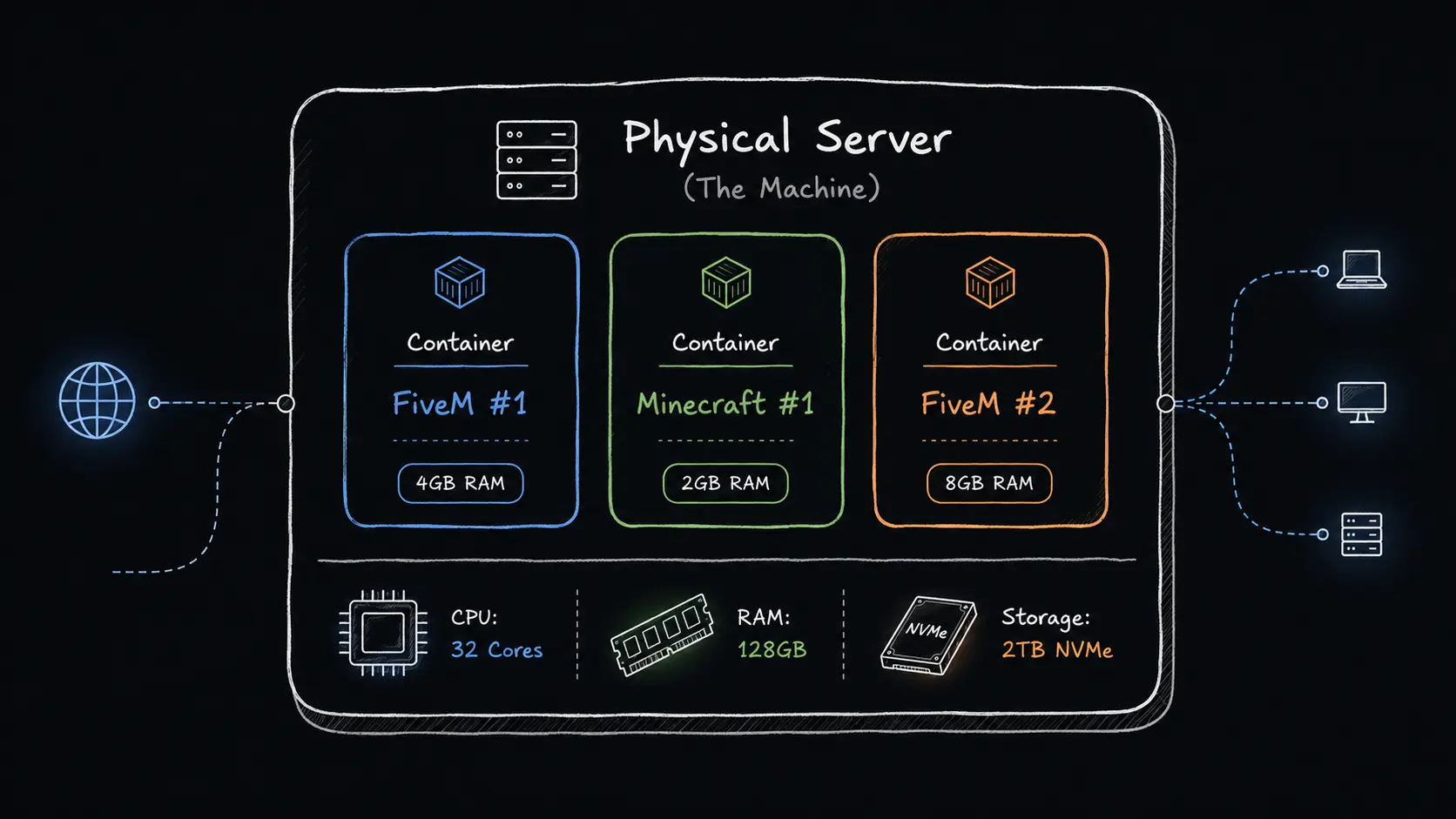
Each container is an isolated slice of that machine. You rent a container. The hosting company manages the physical machine. Pterodactyl, the most widely used game hosting panel, is designed to manage exactly this. It sits on top of Docker containers running on real hardware.
When evaluating any game hosting provider, four questions matter most:
- Where is the physical machine? This determines your ping.
- What CPU does it run? This determines game server performance.
- Is it their machine or someone else's? This determines reliability.
- What happens when it goes down? This determines support quality.
Why single-core CPU speed matters specifically for game servers:
FiveM runs most of its logic on a single thread. Minecraft is similar. A server with 2 fast cores at 5.0GHz will outperform a server with 16 slow cores at 2.5GHz for these games. When you see a provider advertising core count without mentioning clock speed, it is worth asking follow-up questions.
| Spec | Why It Matters for Game Servers |
|---|---|
| Single-core clock speed | FiveM, Minecraft are mostly single-threaded |
| NVMe SSD storage | Fast world chunk loading, database writes |
| RAM | More players and scripts require more RAM |
| Network latency | Every millisecond affects player experience |
| DDoS protection | Game servers are targeted frequently |
The Global Hosting Landscape
To understand where India stands, it helps to see what a mature game hosting market looks like.
Europe
Hetzner, OVH, Nitrado, Contabo, ZAP-Hosting. These are established companies with professional support teams, owned physical infrastructure in Tier-3 data centers, and reputations built over 10 to 20 years. Competition keeps prices low and quality high. ZAP-Hosting has been operating since 2010. That kind of track record reflects a sustainable business, not a startup.
India also has mature infrastructure for web hosting and VPS. Companies like MilesWeb, HostingRaja, and others operate their own data centers and serve enterprise customers reliably. The gap is not in Indian hosting capability overall. It is specifically in the game server hosting category, which has different technical requirements and a different customer profile than traditional web or VPS hosting.
United States
BisectHosting, Apex Hosting, Nodecraft, GTXGaming. Established companies with real infrastructure, real support, and community presence measured in years.
Asia: Singapore as the Default Hub
Singapore has become Asia's game hosting hub. The geographic position gives it reasonable latency to Southeast Asia, South Asia, East Asia, and Australia simultaneously. Major providers have Singapore nodes specifically for this reason.
From most Indian cities, Singapore runs at approximately 70 to 80 milliseconds of ping. Workable for most games. Not ideal, but workable.
Germany runs at 150 to 180 milliseconds. Acceptable for some game types, frustrating for latency-sensitive gameplay.
There is no Indian equivalent in the game server category. India, with 550 million gamers, does not yet have a single globally recognized game server hosting company that the broader gaming community knows and trusts.
The Purchasing Power Parity Problem
This is the section almost nobody writing about Indian hosting includes, and it is arguably the most important structural issue in the market.
Source: World Bank via Trading Economics, 2024
India's GDP per capita adjusted for Purchasing Power Parity was $9,817 in 2024. The global average PPP GDP per capita is approximately $25,591. Source: Trading Economics and Wikipedia
Purchasing Power Parity is the economic concept that explains why a McDonald's meal costs $5 in the US and roughly $1.50 in India. The price is not just about currency conversion. It reflects what that amount of money actually means relative to local incomes and costs.
When a European provider prices a game server at 8 EUR per month, that price is calibrated for a market where incomes are three to four times higher in PPP terms than India. The same 8 EUR carries very different weight in Frankfurt compared to Jalandhar.
| Item | Germany | India (PPP adjusted) | What You Actually Pay |
|---|---|---|---|
| Entry game server | 8 EUR/month | ~280 INR in real purchasing power | ~820 INR at current exchange |
| The gap | You pay approximately 2.9x the PPP-equivalent price |
A 16-year-old in Germany spending 8 EUR on a server is spending a small fraction of what a part-time job earns. A 16-year-old in India spending 720 INR is spending a much more meaningful share of available income. This is structural, not a personal finance problem, and no amount of goodwill from international providers fixes it without a pricing strategy that accounts for it.
The payment friction compounds this further.
International card rejections are a real and documented experience for Indian players trying to pay foreign providers. Many Indian debit cards, particularly from smaller banks or older RuPay-only issuances, are not enabled for international transactions by default. This is exactly what happened when I tried to buy my first server. The workaround of borrowing a friend's card is common in the Indian server community. It should not be the standard onboarding experience.
No major international game hosting company currently accepts UPI, which processes over 14 billion transactions per month in India and is the primary payment method for most Indian internet users under 30.
Banks charge 1 to 3.5% as a foreign currency markup on every international card transaction.
The combined effect: international game hosting costs meaningfully more for Indian buyers than the listed price suggests, and the payment process itself creates friction that Western customers do not experience.
The Indian Game Server Hosting Market Right Now
India has solid web hosting and VPS infrastructure. Companies with owned data centers and professional operations exist and serve enterprise and business customers well. The specific category of game server hosting is where the gap appears.
Game hosting has different requirements than web hosting. It needs high single-core CPU performance, specialized DDoS protection configured for UDP game traffic, low-latency routing optimized for real-time connections, and support staff who understand game server software. These requirements mean that a company excellent at web hosting is not automatically equipped for game hosting.
Here is what I observed across the game-specific hosting market in India.
What to Ask Any Provider Before Buying
The most useful thing I can give you is a set of questions that separate serious operations from surface-level ones.
Ask where their servers physically are. A legitimate provider will give you a specific answer: a named data center in Mumbai, Delhi NCR, or another specific location. A vague answer like "our own cloud infrastructure" or "multiple locations" without specifics is worth probing further.
Ask what CPU their game nodes run. For FiveM and Minecraft specifically, you want to know the single-core clock speed. A provider who cannot answer this question may not have visibility into their own hardware, which happens when capacity is being resold from a cloud provider rather than operated directly.
Ask what DDoS protection they have and what their upstream mitigation capacity is. Real protection has numbers attached. Claiming DDoS protection without being able to specify the mitigation capacity in Gbps is a gap worth noting.
Ask what their support channel is and what the response time commitment is. Ticket systems with committed response windows indicate a more structured operation than Discord-only support.
The Reseller Distinction
Some providers in the Indian game hosting space operate as resellers, purchasing capacity from larger cloud platforms and offering it under their own brand and panel. This is a legitimate business model and how many hosting businesses start globally. The distinction that matters is whether the reseller has a proper commercial relationship with their upstream provider, has negotiated terms that protect their customers, and has a service continuity plan.
The questions above will surface this. A provider running on enterprise cloud capacity with a commercial agreement will answer those questions differently than one operating on free tier credits.
Support Structure
Discord is a useful community tool but it is not a support system. A ticket with a reference number, a committed response window, and an escalation path is the baseline for taking customer service seriously. When something goes wrong at 10pm on a Saturday with players waiting, the difference between a ticket system and a Discord channel is significant.
What Looks Promising
There are Indian providers building genuine infrastructure with owned hardware, INR billing, GST invoices, and technical teams who understand game server requirements. I am watching them. What they need is time to build the operational track record that converts cautious optimism into confident recommendation.
The VPS Route and the Gaming Policy Problem
Serious server owners running large FiveM communities or multiple servers often move to VPS hosting for better control and value at higher specs.
When I approached several Indian VPS providers about game server use, I was declined by some. Not for technical reasons. The word "gaming" in my application triggered automatic rejection from certain providers.
The context: India's 2025 Online Gaming Regulation Bill imposed strict rules on online money games and resulted in a significant number of betting and gambling sites being blocked. Some VPS providers responded with blanket policies against gaming-related hosting, even though FiveM roleplay and Minecraft have no connection to online money games whatsoever.
This is not universal. Many Indian VPS providers will host game servers without issue. But the pattern is real and worth knowing about.
If you are applying to an Indian VPS provider for game server use, be specific about what you are running. "Minecraft Java Edition multiplayer server for a private community" or "FiveM roleplay framework, community operated, no financial transactions" gives the provider the context to evaluate your use case accurately instead of pattern-matching to a blanket policy.
The Summer Server Pattern
If you have been in the Indian gaming community for more than a year, you recognize this.
Summer vacation and December breaks trigger a wave of new server activity. Friend groups that have been planning a Minecraft SMP or FiveM RP city finally have the time. Someone buys a server. Someone installs the mods. A Discord gets created. Everyone is genuinely excited.
Six to eight weeks later, college reopens. The person paying for the server goes back to studying. The server sits idle. Nobody wants to keep paying for something nobody is using. The server closes. The world is deleted because nobody downloaded a backup.
This plays out every year across thousands of Indian communities. No hosting product is built specifically for it.
What summer server owners actually need:
- Monthly billing with no annual commitment and no cancellation penalty
- Simple world export and backup before closing the server
- Setup that does not require Linux knowledge
- INR pricing with UPI payment
- Cost that makes sense when split across four to six friends
What exists for this use case:
Nodecraft Lite runs servers only when players are active, with a wake-on-demand share link so anyone in the group can start the server without the owner being online. For a summer server where sessions are sporadic rather than daily, this avoids paying for idle uptime.
BisectHosting monthly billing with no cancellation penalty works if you remember to export your world before closing the account.
Aternos is free and functional for three or four friends playing casually. The queue system and European latency make it frustrating for anything more serious.
The real reason summer servers die is not the hosting cost. A decent Minecraft server for 10 players costs roughly 600 to 800 INR per month. Split across six friends, that is under 150 INR each. Less than a movie ticket. Servers die because one person ends up carrying the cost and resents it by week four. Establish a shared payment system before the server starts, not after.
What Serious Indian Game Hosting Would Look Like
This is both a critique of what is missing and a blueprint, because someone will build this and it should be built correctly.
Infrastructure
Mumbai and Delhi nodes with actual physical hardware in Indian Tier-3 data centers. Not Singapore traffic routed through India. Not cloud capacity resold under an Indian brand. Real hardware, real location, sub-30ms ping to most Indian players.
DDoS protection specifically configured for game traffic, which is predominantly UDP. The protection capacity needs to be real, documented, and tested. Asking a provider to share their mitigation upstream details is a reasonable due diligence question.
Single-core CPU performance appropriate for FiveM and Minecraft workloads. A Ryzen 9 5950X running at 4.9GHz serves game servers better than a high core-count server with lower clock speeds.
Business and Payment
INR billing with UPI support. This is the single most direct way to serve Indian players. UPI is how this demographic pays for everything. A hosting company without UPI is asking its core customers to jump through extra hoops on every renewal.
GST invoices. Required for any server owner or business that needs proper tax documentation.
Pricing that reflects Indian purchasing power. A well-priced entry plan in INR that delivers genuine quality is more compelling to the Indian market than a competitive EUR price that requires an international card and forex fees.
Support
Ticket system with response time commitments. This is the baseline for operating a professional hosting service. Discord is a great community channel. It is not a support system.
Community
Presence in the communities being served. The game hosting companies that earn long-term trust are the ones that show up in FiveM Discord servers, Minecraft communities, and content creator ecosystems. Not through advertising but through genuine helpfulness. This cannot be shortcut.
For International Brands: The Indian Market Is Easier Than You Think
Established international brands have significant advantages over new Indian entrants when it comes to entering this market.
They already have proven infrastructure and operational processes. They already have reputations that Indian players know and partially trust. They have legal and compliance frameworks in place. The Indian gaming community knows ZAP-Hosting, BisectHosting, and Apex Hosting. They watch the same tutorials, read the same reviews, and participate in the same global communities.
What these brands are missing for India is relatively specific:
An Indian datacenter node. Mumbai or Delhi. This is capital investment but it is the most direct way to serve the market.
INR billing with UPI support. Payment processors like Razorpay, PayU, and Cashfree make this straightforward to implement.
Indian support coverage aligned to IST. UTC+5:30 matters when your customers are reporting issues during Indian evening hours.
Content and marketing that speaks to Indian players directly. YouTube tutorials in Hindi and English, presence in the right Discord communities, partnership with Indian creators who already have the trust of this audience.
The Indian market does not need to be built from scratch by these companies. The audience already knows them. The gap is in serving that audience with infrastructure and payment options that actually work for them.
For international hosting companies
If you are an established hosting brand thinking about the Indian market, I am interested in conversations about content, marketing, and community strategy. I have spent six years building an audience of exactly the players and server owners you want to reach. Get in touch
The South Asia Angle
An Indian hosting company with genuine Mumbai or Delhi infrastructure is not just positioned to serve India. The same hardware delivers 40 to 60ms latency to Pakistan (240 million people), Bangladesh (170 million), Nepal, and Sri Lanka. The South Asian gaming community is large and almost entirely served by Singapore or European providers because no local alternative exists.
There is also the diaspora angle. Indian communities in the UK, USA, Canada, UAE, and Australia play games with friends and family back home. A server in Mumbai solves a latency problem that no London or Frankfurt server can address.
The addressable market for a serious Indian game server hosting company is not just 550 million Indian gamers. It is the broader South Asian gaming community and diaspora globally.
Current Recommendations
Until Indian providers build enough track record for confident recommendation, here is what I would tell someone asking today.
Small friend group, casual or summer server (under 15-20 players): Start with Aternos to test whether the group actually plays consistently. If they do, move to a monthly paid plan on BisectHosting, ApexMinecraftHosting or similar. Budget 800 to 1200 INR per month and download your world backup before you cancel.
Mid-size Minecraft SMP (20 to 50 players): VPS in Singapore. Expect 70 to 80ms ping for Indian players. This is currently the best reliability option at this scale.
Serious FiveM RP community (50+ players, custom scripts): VPS in Singapore or Germany with strong single-core CPU performance and real DDoS protection. This is not the place to optimize for cost over specs. If your community generates donation revenue, hosting is a business expense and should be treated as one.
Learning and development: ZAP-Hosting's lifetime VPS in Germany and USA at 64 EUR once is good value for a development environment you plan to keep for more than eight months. I wrote a full review here.
What I Am Watching
The Indian game server hosting market will look different in two to three years. The demand is too large and the gap too visible for it to remain as it is.
Specifically: an established international provider adding a genuine Indian node with INR billing would change the recommendation landscape immediately. An Indian provider accumulating enough independent track record to be recommended with confidence will take longer but the trajectory exists.
I will update this post as things change. Follow the YouTube channel if you want to know when that happens.
Running a server in India?
I have been building FiveM and Minecraft servers since 2020 and have made most of the mistakes worth making. If you need guidance on hosting choices, VPS configuration, Pterodactyl setup, or server optimization, reach out. I offer setup services and am happy to point you in the right direction even for simple questions.
Contact me here or join the Discord
Hosting company? Let's talk.
If you are building or running a game hosting company targeting Indian or South Asian players, I would like to hear from you. I cover this space with nearly 10,000 subscribers who are exactly your target audience. Open to partnerships, affiliate arrangements, disclosed sponsorships, and consulting on Indian market strategy.
Get in touch or email me at hello@yuvrajverma.com
Written by
Yuvraj Verma
Yuvraj Verma writes practical guides on hosting, monetization, and game server infrastructure.
His content is built to help creators and hosting businesses launch faster with fewer mistakes.
Next articles
Read these next
FiveM Server Hosting in 2026: Official Partners Compared
Compare all six authorized FiveM hosting partners in 2026, plus Godlike.host as a budget-friendly FiveM hosting option.
Open articleZAP-Hosting ZapX: My Thoughts as a Customer Since 2020
My customer-focused look at ZAP-Hosting ZapX, the new dashboard, beta testing, VPS snapshots, firewall, IPv6, file manager, remote desktop, Cloudflare/DNS sync, AI Shop Assist, and Scale Assist.
Open articleNodecraft Pro vs Lite: Which Game Server Plan Should You Pick?
A practical Nodecraft Pro vs Nodecraft Lite comparison for Minecraft, Rust, Valheim, Palworld, and casual game servers. Learn when Lite is enough, when Pro is worth it, and what the real tradeoff is.
Open article